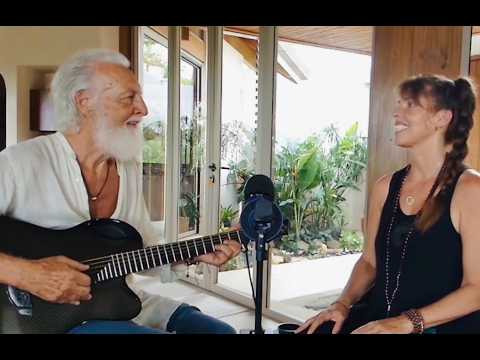
Miten's "Awakening," performed live with Deva Premal and Manose in 2008, is a devotional chant that explores the core experience of spiritual awakening through multiple lenses: awakening to the calling of the mystic, to a long forgotten memory, and to the perfect imperfection of oneness. The song uses collective singing and repeated invitations to participatory presence to embody the very awakening it describes. Rather than a teaching about awakening, this is awakening itself rendered audible—a practical enactment of how consciousness recognizes itself through group presence and sacred sound.
What Does It Mean to Awaken to the Mystic Calling?
The opening line sets the frame: "We are awakening to the calling of the mystic" (0:22). Miten's use of "we" is deliberate. This is not an individual's private realization but a shared invitation into recognition. The "calling of the mystic" refers to a summons that arises from beyond the ordinary mind—a pull toward dimensions of experience that the surface self does not perceive or understand. In the context of Miten's performance, this calling comes alive in real time through the convergence of voices, the presence of the community gathered, and the opening of the heart.
The first verse continues with resonant phrases: "In the flowering of the heart. Everybody here melting into presence, overflowing effervescence, rising in love" (0:30–0:49). Note the progression. The heart flowers—it does not think itself into awakening but opens as a natural unfolding. Once the heart opens, presence becomes tangible: "melting into presence" suggests a dissolving of the boundary between observer and observed, a softening into what is already happening. That softening generates "overflowing effervescence"—a bubbling, vital energy that is not forced but arises from the melting itself. Finally, all of this rises "in love," suggesting that the entire movement from heart-opening through presence through effervescence is fundamentally an expression of love.
This first verse establishes the central arc: awakening is not a destination but a recognition, and that recognition is embodied, collective, and rooted in the heart rather than abstraction.
How Does Awakening Connect to a Forgotten Memory?
The second verse shifts focus: "We are awakening to a long forgotten memory. Dawn is breaking. Waves are coming in and everybody here standing in wonder beneath the rain and the thunder, rising in love" (0:73–0:102). Here, Miten introduces a paradoxical dimension of awakening: it is not the discovery of something new but the recognition of something ancient that consciousness has overlooked.
This "long forgotten memory" can be understood in several ways. Spiritually, it may refer to the original unity of awareness before it fragmented into subject and object, self and other. Miten's image of "dawn breaking" and "waves coming in" evokes natural cycles—the return of light, the rhythm of the tides. These are not unprecedented events; they recur ceaselessly. Yet when genuinely perceived, they strike us with wonder. The image of standing "beneath the rain and the thunder" suggests being subject to forces larger than the personal self, held within a natural order that is both vast and intimate.
The spiritual implication is clear: awakening is simultaneously a return and a first seeing. We recognize something that has always been present but that our habitual consciousness had obscured. The collective standing "in wonder" under these elemental forces mirrors the act of the community in the room coming into genuine presence together.
What Is the Role of "Om Shanti" in This Awakening?
Beginning at 0:113, Miten introduces "Om Shanti"—"peace"—repeated as a refrain. In classical Sanskrit usage, "Om" is the primordial sound, the mantra that encompasses all manifestation. "Shanti," repeated three times in traditional contexts, means peace at the level of body, mind, and spirit. Here, Miten uses "Oh Shanti" as an invocation and a settling point.
The chanting of "Om Shanti" serves multiple functions in the performance. First, it offers an anchor—a return point when the mind, even in the midst of awakening, seeks ground. Second, it transfers the awakening from conceptual understanding to direct, embodied experience. When one chants "Om Shanti" in unison with others, one is not thinking about awakening; one is enacting it. The nervous system synchronizes with the voices around it. The breath aligns. The sense of "I" momentarily relaxes into "we."
The rhythmic repetition of "Om Shanti" also mimics the ocean waves mentioned in the second verse—it is cyclical, natural, and inexorable, carrying the individual awareness beyond its usual boundaries.
What Does Perfect Imperfection Mean in the Context of Awakening?
The third verse introduces a refined subtlety: "We are awakening to this perfect imperfection, awakening in the oneness of everybody here. Part of each other, sister and brother, rising in love" (1:94–2:23). This phrase—"perfect imperfection"—cuts against the grain of conventional spiritual aspiration, which often seeks a flawless, transcendent state.
Miten's invocation of "perfect imperfection" suggests that awakening is not the attainment of a state that lacks flaw or contradiction. Rather, it is the recognition of the completeness that exists within and through the broken, limited, relative nature of existence as it actually presents itself. A human being is imperfect: the body ages, the mind wanders, relationships involve conflict and misunderstanding. Yet within that imperfection lies a perfection—the perfection of authenticity, of being what one is without pretense.
This awakening is "in the oneness of everybody here"—not in the private transcendence of the individual but in the recognition that all the imperfect beings in the room are expressions of a single awareness. Miten then clarifies: "Part of each other, sister and brother." The divisions that appear to separate one being from another dissolve into a recognition of kinship. The imperfection of the other becomes the perfection of the beloved, the mirror, the one through whom you know yourself.
This verse is essential because it prevents awakening from becoming a rarefied, isolated state divorced from the messy reality of human relationship and embodied life. Instead, awakening happens in and through the depths of our actual imperfection.
How Does Participation and Invitation Function in This Chant?
At 2:95, Miten explicitly turns to the audience: "Go ahead and sing that with me. We are awakening." This is not a passive listening experience. Miten invites direct participation. The audience becomes co-creators of the awakening that the song describes.
This move is pedagogically brilliant. It honors a cardinal principle in contemplative traditions: transformation cannot be given; it can only be participated in. By singing the words themselves, by matching breath to Miten's breath, by allowing the vibration of the mantra to move through one's own body, the listener becomes the subject of awakening rather than an observer of someone else's spiritual experience.
The final minutes of the chant are structured around repetition and building momentum: "We are awakening. We are awakening. Awakening. We are awake." The variations in phrasing—from future tense ("are awakening") to present tense ("are awake")—suggest a temporal movement from the recognition of awakening as a process to the claiming of awakening as a realized state. Yet the movement is not linear; it cycles, returning again and again to the affirmation as though the affirmation itself is what sustains the recognition.
What Is the Spiritual Function of Group Chanting?
Throughout the performance, Deva Premal and Manose provide musical accompaniment—harmonies, instrumental support, and vocal echoes. This is not Miten as soloist with a backing band; it is a genuine ensemble in which individual voices and instruments weave into a unified field. The presence of multiple musicians models the "oneness of everybody" that Miten sings about. Each voice remains distinct; the whole emerges from that distinction.
Group chanting, according to multiple contemplative traditions, creates a coherence field that exceeds the sum of individual efforts. When many people align their breath, their intention, and their sound around a single phrase or mantra, the nervous systems of those participants tend to synchronize. This synchronization is measurable at the physiological level—heart rate variability, EEG patterns, and other markers of coherence shift. At the subjective level, participants often report a dissolution of the boundary between self and other, a sense of being held within something vast and intelligent.
Miten's explicit invitation—"Sing that with me"—harnesses this principle. The audience does not witness spiritual awakening; they enact it. In that enactment, the words cease to be mere words and become a lived experience of the truth they name.
Where to Go From Here
The performance of "Awakening" is an open door. If you have heard this chant or witnessed it in person, several practices flow naturally from it:
- Return to the mantra "Om Shanti." Sit quietly and chant this phrase for 5–10 minutes. Notice how the sound affects your nervous system, how the syllables land in your body, how the repetition begins to dissolve the chattering mind.
- Explore the phrase "We are awakening" in your own practice. What does it feel like to claim this not as a future aspiration but as a statement of what is already occurring? How does the shift from "I am awake" to "we are awakening" change your sense of what awakening is?
- Seek out live kirtan or group chanting experiences. The power of Miten's performance comes significantly from its communal dimension. Recorded versions offer value, but the alchemy of singing in a room with others—breathing the same air, moving through the same passages together—is irreplaceable.
- Study the concept of "perfect imperfection" in your own life. Notice where you are trying to be flawless or transcend your humanity. Consider the possibility that your incompleteness, your limitations, your very vulnerabilities are the gateway to awakening, not obstacles to it.
- Practice singing with others. You need not be trained in music or spirituality. The act of singing together—in a choir, in a group chant, even informally with friends—is a direct gateway into the experience Miten describes. The voice is a bridge between individual and collective consciousness.
Miten's "Awakening" is ultimately a practical teaching: awakening is not a concept to understand but a state to embody, and that embodiment happens most fully in the presence of others, through the marriage of sound and silence, intention and receptivity, individual voice and collective chorus.