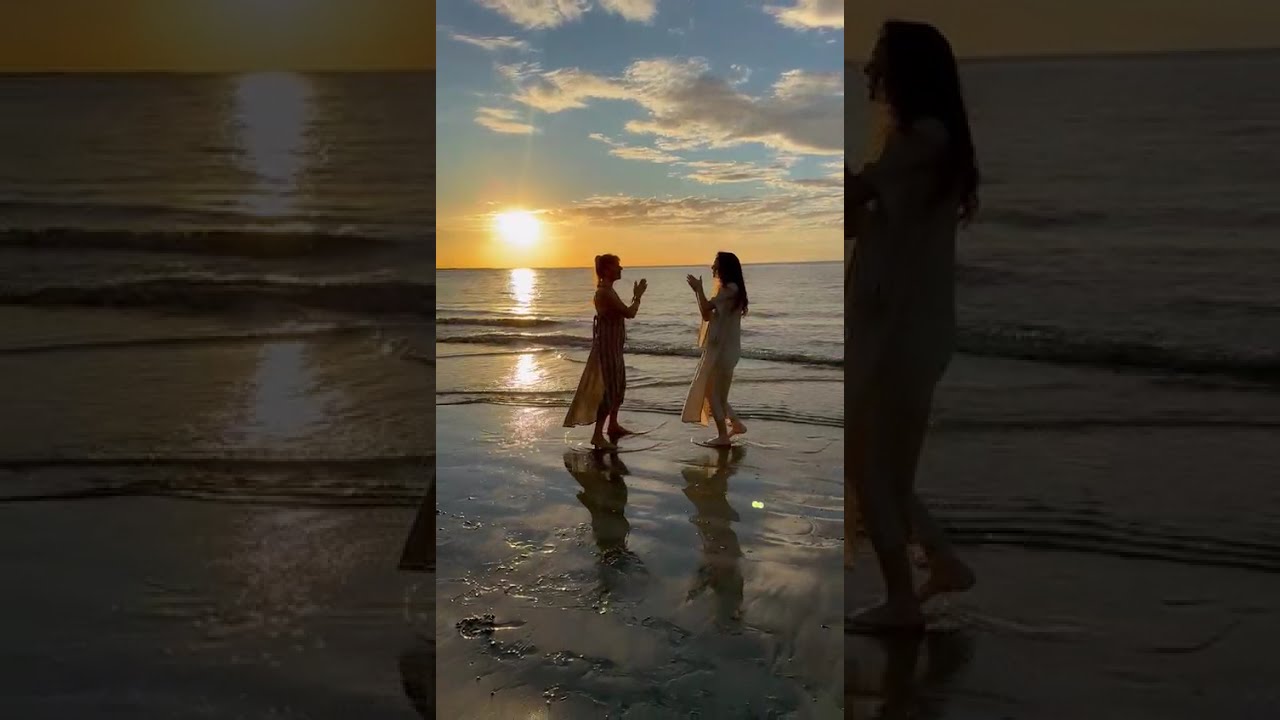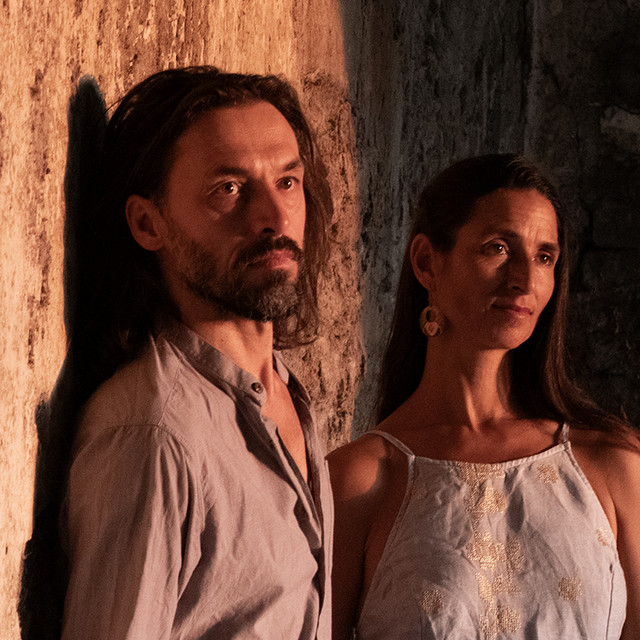
Mirabai Ceiba performs a live kirtan rendition of "Song of the Stars," a traditional Algonquin Indian chant that frames celestial bodies as singing beings whose light is voice, and whose luminescence creates a passage for spirits to travel. The performance, recorded at Hungary's Everness Festival, distills Indigenous cosmology into a simple, resonant vocal meditation on the nature of light, sound, and spiritual navigation.
What Is "Song of the Stars"?
"Song of the Stars" originates from Algonquin Indian oral tradition. The chant is built on a foundational metaphysical proposition: that stars are not merely inert astronomical objects, but sentient, singing beings. The text declares, "We are the stars who sing / We sing with our light." This collapses the distinction between sight and sound. In this cosmology, luminescence and vocalization are one phenomenon—the stars do not sing *about* light; their light *is* their song.
The chant continues: "We are the birds of fire / We fly over the sky." Here, the stars are reimagined as creatures of flame and flight, traversing the heavens. Then comes a crucial shift in function: "Our light is a voice / We make a road / For the spirits to pass over." The stars' light-as-voice becomes infrastructure, a pathway. This suggests that spiritual entities—whether ancestors, deities, or consciousness itself—require luminous passage, and that the stars actively create this passage through their song.
How Does Mirabai Ceiba Interpret the Chant?
Mirabai Ceiba is a kirtan artist known for bringing Indigenous and devotional chants into live performance. In her rendering at Everness Festival, she sustains the Algonquin text with minimal ornamentation, allowing the metaphors to unfold directly. The approach is contemplative rather than theatrical—her voice becomes an instrument for channeling the chant's cosmology rather than imposing interpretive layers.
The live context matters. At Everness Festival, an outdoor event in Hungary focused on consciousness and transformation, Mirabai Ceiba performs in community. The audience responds with applause at moments of vocal crescendo, creating a feedback loop: the singer's voice invokes the stars' song, and the listeners' response echoes back, mirroring the chant's own description of voices creating pathways. The performance is not a concert performance in the conventional sense, but a co-creation between vocalist and listeners.
What Does the Imagery Teach About Light and Sound?
The chant operates on a principle familiar in both mystical and quantum contexts: that light and sound are not separate phenomena but expressions of a unified energetic field. When the Algonquin text states, "Our light is a voice," it proposes that every photon carries information—that luminescence is itself a form of communication. This parallels modern physics (light as wave and particle, frequency as fundamental) while remaining rooted in Indigenous perceptual wisdom.
The notion of stars as "birds of fire" evokes mobility and agency. Stars are not fixed points but active travelers. In Indigenous astronomy, stars track seasons, guide migration, and structure time. By calling them birds, the chant acknowledges this dynamism and suggests that celestial motion is purposeful—a flight, not a drift.
What Role Do the Stars Play in Spiritual Passage?
The final image—"We make a road for the spirits to pass over"—reveals the chant's deepest function. Stars are not merely observed; they are *infrastructure for consciousness*. The phrase "road for the spirits" suggests that immaterial entities (ancestors, soul, cosmic consciousness) navigate by stellar light. This is both literal and metaphorical. Literally, stars have historically guided navigation for humans and animals. Metaphorically, the image proposes that spiritual development or evolution follows luminous pathways—that consciousness itself is lit by the stars' song-voice.
The road-making metaphor is crucial. A road is neither a destination nor a barrier; it is a *passage*. The stars do not carry spirits or create spirits; they create the *condition of passage*. This suggests a non-interventionist cosmology: the sacred does not impose, but enables. Light-as-voice-as-road is an offering, a clearing, an opening.
How Is the Chant Situated Within Kirtan Tradition?
Kirtan is a Sanskrit term meaning "to praise" or "to narrate." It traditionally refers to call-and-response chanting in Hindu and Sikh devotional contexts. However, the practice has expanded globally to include Indigenous chants, secular mantras, and ecological invocations. Mirabai Ceiba's choice to perform an Algonquin chant within a kirtan context signals a deliberate bridging: recognition that devotional vocalization transcends cultural boundaries and that Indigenous wisdom traditions deserve the same sacred attention as Eastern religious frameworks.
The album *Sevati*, from which "Song of the Stars" is drawn, exemplifies this cross-cultural approach. Ceiba's work generally weaves together Sanskrit, Spanish, English, and Indigenous languages, suggesting that spiritual practice is multilingual and that all traditions contain valid paths to the sacred.
What Happens When Kirtan Meets Festival Culture?
Everness Festival, held in Hungary, bills itself as a gathering for consciousness exploration. The presence of kirtan—an inherently participatory, non-hierarchical vocal practice—within a festival setting creates a particular space. Attendees are invited into a call-and-response structure (even if only as listeners), creating a shared vibrational field. The applause at 31 seconds in Ceiba's performance marks a moment of collective recognition—the audience has felt the chant move through them and responds with affirmation.
This context transforms what might be a concert into a ritual. The festival ground becomes a temporary sangha (spiritual community), and the chant becomes a shared invocation. The stars themselves are invoked not as remote celestial objects but as present, singing companions in the gathering.
What Is the Significance of the Algonquin Source?
The Algonquin peoples (Haudenosaunee, Anishinaabe, Mi'kmaq, and related nations) developed cosmologies grounded in direct observation of sky, land, and water. Their astronomical knowledge shaped calendars, agricultural timing, and spiritual ceremonies. By singing an Algonquin chant, Mirabai Ceiba centers Indigenous knowledge and acknowledges that Europe (where the festival occurs) has its own indigenous roots beneath colonial overlays—and that other traditions, like those of North America, carry comparable depth and validity.
The chant's attribution to "the Algonquin Indians" in the album notes signals respect for source while also raising questions about exact lineage (Algonquin is a broad linguistic group). The care in crediting reflects a growing awareness within global kirtan and spiritual music communities that appropriation and erasure are real risks, and that source acknowledgment matters.
Where to go from here
If "Song of the Stars" resonates, consider exploring Mirabai Ceiba's full discography, particularly *Sevati*, to encounter additional cross-cultural chants. Listen to the track in both studio and live contexts to perceive how performance setting shapes meaning. Research Algonquin astronomical traditions and creation stories to deepen understanding of the chant's cosmological roots. Engage in kirtan practice yourself—whether through online resources, local sanghas, or recordings—to move from listening into participatory vocalization. Finally, sit with the central image of light-as-voice-as-passage: What does it mean to you that luminescence communicates, guides, and creates pathways for consciousness?